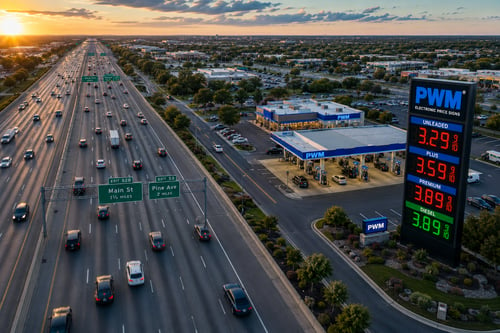
For decades, roadside signage at gas stations had one primary job: tell drivers the price of fuel. That function remains critical, but today’s digital signage can do much more.
Fuel retailers and convenience stores are increasingly treating digital displays as communication and marketing tools that connect the gas station, convenience store, car wash, foodservice program, loyalty program, and other services. Instead of displaying only a price per gallon, modern signage can help operators tell passing drivers why they should stop and what else they can buy once they arrive.
That shift is especially important as convenience retailers look beyond fuel sales for growth. According to the National Association of Convenience Stores (NACS), U.S. convenience stores generated $341.2 billion in foodservice and merchandise sales in 2025, marking the 23rd consecutive year of growth in inside sales. Foodservice alone represented 28.5% of in-store sales and 38.9% of in-store gross profit dollars.
For fuel retailers, those numbers highlight an important opportunity: the customer who pulls in for gas can be worth significantly more when signage helps introduce everything else the location has to offer.
Turning the Roadside Sign Into a Marketing Tool
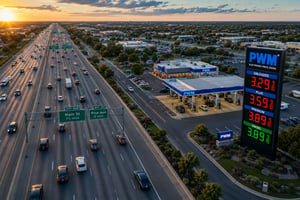
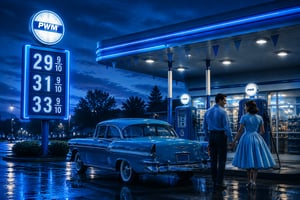
A fuel price sign may be the first interaction a driver has with a station. The price sign is the “business card” of a gas station, emphasizing the importance of reliability, legibility, and appearance.
Digital technology expands what that business card can communicate.
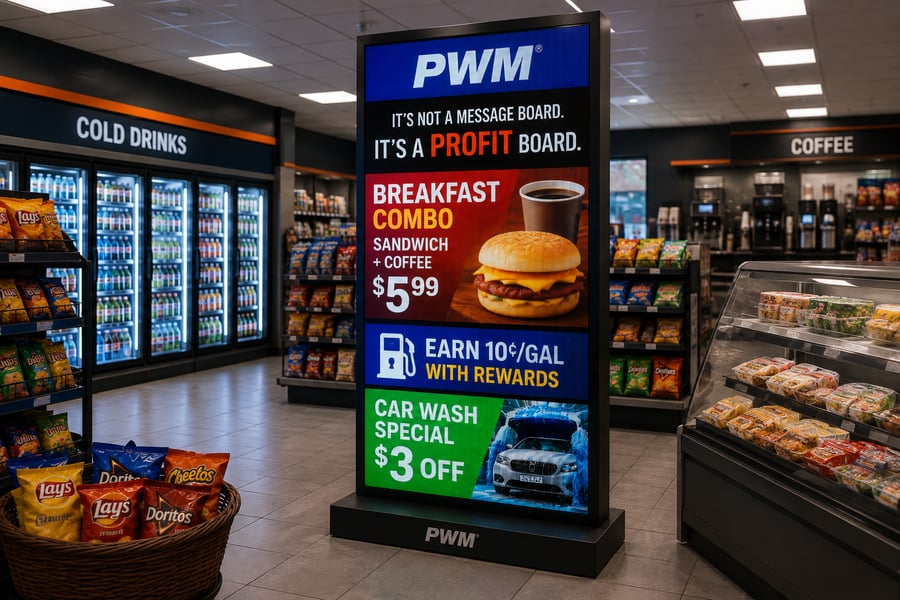
PWM’s LED profit boards and message displays, for example, can be used to advertise in-store promotions, community messages, loyalty programs, car washes, convenience-store specials, and other non-fuel services.
Imagine a driver approaching a station and seeing more than $2.99 per gallon. A digital message could also communicate:
“Fresh Breakfast Sandwich + Coffee — $5.99”
or:
“Save 10¢/Gallon With Rewards”
or:
“Car Wash Special Today”
Suddenly, signage is doing two jobs. It communicates essential fuel information while giving customers another reason to visit the property or walk inside.
Promoting Higher-Value In-Store Purchases
Getting customers from the pump into the store remains an important opportunity for fuel retailers.
NACS reported that fuel represented 65% of convenience-store sales dollars in 2025 but only 38.8% of gross profit dollars. Meanwhile, foodservice accounted for 38.9% of in-store gross profit dollars.
That helps explain why promoting coffee, prepared foods, beverages, snacks, and other in-store products can be so valuable.
Digital signage gives retailers the flexibility to change those messages based on what matters at a particular time.
A store could advertise coffee and breakfast in the morning, lunch specials around noon, cold beverages during a hot afternoon, and dinner bundles during the evening commute. Instead of committing valuable sign space to one static promotion, operators gain the ability to adapt messaging as customer needs change.
Building Loyalty Program Awareness
Loyalty programs have become another important component of the fuel and convenience-store experience. But a loyalty program only works when customers know about it.
Digital signage can make rewards messaging more visible before a customer ever enters the store.
Retailers can highlight cents-per-gallon discounts, member-only pricing, app-based offers, points programs, or limited-time rewards. PWM specifically identifies loyalty programs as one of the marketing opportunities available through its message displays and profit boards.
This approach can help turn a transactional fuel stop into an ongoing customer relationship. Instead of competing exclusively on today’s posted price, retailers have another way to communicate the long-term value of choosing their brand.
Putting the Spotlight on Car Washes and Other Services
The modern fuel station is increasingly a multi-service destination.
Car washes are one example. Others may include quick-service restaurants, ATMs, propane, truck services, alternative fuels, or EV charging, depending on the property.
PWM notes that the modern gas station is evolving as gasoline and diesel are joined by options such as EV charging, CNG, propane, and hydrogen. Digital signage can help retailers communicate those offerings as part of one consistent brand experience.
That matters because drivers cannot purchase a service they do not realize is available.
A prominent digital message advertising a car wash, EV charger, fresh-food program, or other amenity can introduce the service to thousands of passing motorists without requiring a separate advertising campaign.
Communicating Community and Operational Messages
Not every digital message has to sell something.
PWM notes that digital signage can also display community messages and emergency alerts.
That opens the door to messages such as holiday greetings, local event information, weather-related notices, store-hour updates, hiring announcements, or other timely communications.
For multi-location retailers, digital signage can also help maintain consistency. A promotion can be coordinated across multiple locations while still giving individual stores flexibility to communicate information relevant to their local market.
Managing Signage More Efficiently
The value of digital signage is not limited to what customers see. It can also change how operators manage their locations.
PWM offers a web-based dashboard with real-time information and diagnostics, along with remote price-change capabilities that can connect to a retailer’s point-of-sale system. Its Hybrid Control Gate controller offers built-in integrations with all major POS brands and many smaller systems.
Remote capabilities become especially valuable for operators overseeing multiple locations. Instead of relying on employees to manually change signs, retailers can manage information more efficiently and reduce opportunities for inconsistencies or human error.
PWM’s TRACK technology goes even further by allowing real-time monitoring and control of individual SMD LEDs, supporting proactive maintenance and faster responses to potential display issues.
That combination of marketing flexibility and operational control is what makes modern signage different from the static signs of the past.
Visibility Still Comes First
More messaging does not automatically mean better signage. Drivers often have only seconds to see, understand, and respond to a roadside message.
PWM emphasizes that effective visibility depends on factors including digit height, viewing angle, sign placement, lighting conditions, roadway speed, and surrounding obstacles.
Technology plays a role as well. PWM’s SMD LED price-sign digits are designed to provide increased viewing angles, energy efficiency, resilience, and IP67 waterproofing. PWM was also the first manufacturer to develop the first mass-produced white sign digits in 2007 and introduced full-color digits in 2015.
The goal is not to overwhelm drivers with information. It is to use the available display space strategically, delivering a short, relevant message that can be understood quickly.
Digital Signage Is Becoming Part of the Entire Customer Journey
The future of fuel retail signage is bigger than the fuel price.
A driver may first notice a retailer because of a bright, easy-to-read price display. A message board can then introduce a food special, loyalty discount, or car wash. Additional signage around the property can reinforce those offers and help move the customer from the roadway to the pump and, ideally, into the store.
That matters in an industry where every customer interaction counts. In 2025, the average U.S. convenience store handled approximately 45,160 transactions per month, or 1,484 per day, according to NACS. Each transaction creates an opportunity to increase awareness, strengthen loyalty, and introduce customers to additional products and services.
PWM Electronic Price Signs offers a range of technologies designed for this evolving environment, including SMD/LED price sign digits, Profitboard LED Message Centers, pump toppers, high-rise digits, TRACK communication technology, remote price management, and other digital signage solutions. PWM’s systems can be found in more than 120 countries, with thousands of signs installed and relationships with major fuel brands worldwide.
Make Your Signage Work Harder for Your Business
Your roadside display can do more than tell customers what fuel costs. With the right digital signage strategy, it can promote foodservice, advertise a car wash, build loyalty-program awareness, highlight new services, communicate timely messages, and strengthen your brand, all while helping your location remain visible to passing drivers.
Whether you are upgrading an existing station, modernizing multiple locations, or looking for new ways to turn fuel traffic into higher-value customer visits, PWM Electronic Price Signs can help you find a signage solution built around your operation.
Contact PWM Electronic Price Signs to explore digital signage solutions for your fuel retail locations.